Publicly-expressed opinions of current senior military officers are rare in democracies, having the potential to carry outsized weight, to shape public opinion, and to constrain government policy-making. The current trend is disturbing.
Read more
Publicly-expressed opinions of current senior military officers are rare in democracies, having the potential to carry outsized weight, to shape public opinion, and to constrain government policy-making. The current trend is disturbing.
Read more
Threads of former dark episodes in America’s past are woven through its 2025 National Security Strategy. Unmistakable echoes of anti-democratic elitism, race theories, and eugenics. America’s allies should be alarmed at the vision promised to be imposed by strength and direct interference.
Read more
To stop the war in Ukraine the Europeans will need to untie two Gordian knots: an intractable problem of security guarantees, with risk of a stand-off between Europe and Eurasia emerging, and seemingly irresolvable competing territorial claims.
Read more
In a bold stroke of strategic genius in pursuit of peace in Ukraine, the Europeans – well, France and the United Kingdom – have decided on a course of action that will ensure the war’s continuance. How can the observer make sense of this?
Read more
If control of the Eurasian land mass is seen as the key determinant in great power relations, the war in Ukraine gives a sharper focus to longer term geopolitical shifts, foreshadowing the retreat of the American sphere and America’s decline as a global power.
Read more
If he wins, Donald Trump says he could bring about the cessation of hostilities in Ukraine between his election and inauguration. Trump’s peacemaking could trigger a series of seismic geopolitical shocks. Even NATO’s survival might be in doubt.
Read more
By 2028, the next US administration may need to decide between adherence to the AUKUS deal as structured, or ensuring the operational viability of America’s own nuclear submarine force. Is there potential for the US to withdraw from AUKUS?
Read more
At some point there must come a crisis. The G7 and their allies and partners will either have to cease their support for Ukraine as the toll and costs become too great, or decide that the defeat of Russia is of such importance to them collectively that they engage militarily in the conflict.
Read more
Over and over, generations of political leaders have fallen for the delusion that death and destruction bring a resolution to political problems, and people from many nations have bravely sacrificed themselves, whatever the casus belli. To remember their sacrifices is right; but to distort that memory to foster more war is abhorrent.
Read more
How long can Australian politicians continue with the pretence that the American alliance aligns with the nation’s interests? Trump or Biden? It doesn’t really matter except for determining the path of America’s decline into illiberalism. ANZUS must be exited, but the impetus will have to come from voters.
Read more
At this time of rising living costs, economic uncertainty, and impending climate disaster, subsidising the US and UK submarine construction industrial bases is the obvious priority for the Australian government. With massive taxpayer funds flowing through the government’s hands on the basis of media releases, are there yet to be revealed details that will explain to the taxpayer how these contributions aren’t just tributes?
Read more
Australia’s future maritime warfare capability is now to include the ‘Enhanced Lethality Surface Combatant Fleet’. Requiring, like the AUKUS submarines, ambitious naval acquisition and construction programs with long lead-times before delivery, serious questions are raised about how the ELSCF responds to assessments of Australia’s strategic circumstances – and of the extent to which it would be just another contribution by Australian taxpayers to US military forces.
Read more
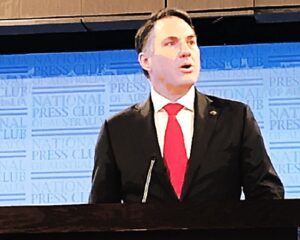
Prime Minister Albanese has announced new commitments to the United States which have the potential to give American institutions and agencies access to the inside workings of Australian intelligence, research, and business in ways that will not be, and could not be, reciprocated.
Read more
As it stands, the leading Republican US presidential hopefuls, and much of their base, are supportive of military action against Mexico. What would it mean if America invaded Mexico in 2025?
Read more
From the moment it was sworn in, the Albanese government has been swept up in a series of defence arrangements with the Americans with far-reaching implications for Australia’s ability to act independently and in its own interests. The nation’s intelligence function is the latest casualty.
Read more
America’s space policy reveals its hegemonic obsession and exposes the future quandaries for Australia. How will Australia confront the inevitable question of whether to support a peaceful or a militarised exploration of space?
Read more
Past experience suggests that the postwar outcome in Ukraine could be a destabilised and failing state. Win, lose or stalemate, the postwar environment in Ukraine is likely to pose significant challenges for the EU and NATO.
Read more
All the signs point to there being no prospect of a sudden upwelling of responsible, considered, and prudent policymaking from Australia’s political class. Without a mature public debate, Australia’s AUKUS submarine farce has been scripted.
Read more
The AUKUS submarines are not expected to get wet until more than 30 years from now, and then to operate until at least the late 21st century. Whatever the government’s thinking is, it cannot centre on a genuine belief that the project addresses Australia’s current pressing strategic needs.
Read more
The latest teaser from the Australian government is the suggestion that the AUKUS submarines could be a brand new common design delivered via ‘an integrated industrial capacity across the three countries’, with ‘the three countries…building different sections of the submarines’. Alarm bells should be ringing.
Read more